
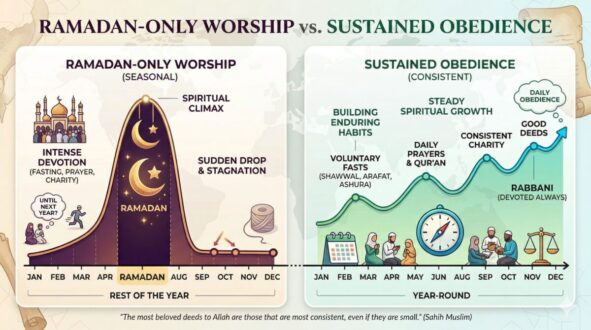
Consistency after Ramadan is the ultimate goal for every believer seeking lifelong spiritual growth. As the scholars of the past wisely cautioned: “Be a Rabbani (devoted to the Lord always), and do not be a Ramadani (devoted only in Ramadan).” While the month of mercy has passed, the true journey of Istiqamah (steadfastness) is just beginning. Achieving true consistency after Ramadan means ensuring the habits we built—prayer, charity, and restraint—do not vanish with the ‘Eid moon.
The departure of the fasting month often brings a sense of spiritual vulnerability, but the essence of the “Ramadan school” is to train a servant who is devoted to the Creator at all times. By focusing on consistency after Ramadan, we avoid being like the person who unravels their spiritual “thread” the moment the struggle ends. This steadfastness is the secret to a heart that remains connected to its Maker throughout the entire year, regardless of the season.
In this 1,000-word comprehensive guide, we will dive deep into the theological roots of Istiqamah and provide a practical Sunnah fasting calendar. From the “Six Days of Shawwal” to the “White Days,” you will discover how to maintain consistency after Ramadan and secure the most important sign of an accepted month: the success to continue doing good deeds long after the month is over.
I. The Spiritual Blueprint for Consistency After Ramadan
The Qur’an provides a powerful psychological and visual warning against losing the progress made during Ramadan. Allah says:
“And do not be like she who untwisted her spun thread after it was strong [by] unravelling it…” (An-Nahl: 92).
This verse refers to a woman in Makkah known as Raytah bint Amr, who would spend all morning spinning a firm, high-quality thread, only to spend the afternoon pulling it apart until it was nothing but a pile of useless fiber. When we spend thirty days building our soul through fasting and night prayers, only to return to negligence and sin on the first day of Shawwal, we are effectively unraveling our spiritual “thread.” Ramadan is meant to be a foundation, not a temporary peak.
II. Defining Istiqamah: The Secret to Consistency After Ramadan
The Arabic term for steadfastness is Istiqamah. It is a word that carries immense weight in Islamic jurisprudence.
1. The Most Concise Definition of Islam
Sufyan ibn Abdullah Ath-Thaqafi once approached the Prophet (peace be upon him) seeking a singular piece of advice that would encompass the entirety of the religion. The Prophet (PBUH) responded with just five words in Arabic:
“Say: ‘I believe in Allah,’ and then remain steadfast.” (Sahih Muslim, 168).
This indicates that while faith (Iman) is the engine, steadfastness (Istiqamah) is the steering wheel. Without it, the engine eventually stalls.
2. Why the Prophet (PBUH) Turned Gray
The command to remain steadfast was so demanding that it physically affected the Messenger of Allah. Ibn Abbas (may Allah be pleased with them) noted that the verse: “So remain as you are commanded” (Hud: 112) was the most difficult for the Prophet to bear.
Abu Bakr (may Allah be pleased with him) once remarked, “O Messenger of Allah, you have turned gray.” The Prophet replied: “Surah Hud and its sisters [Al-Waqi’ah, Al-Mursalat, An-Naba’, and At-Takwir] have made me gray” (Tirmidhi, 3308). Scholars explain that it wasn’t the stories of the past nations that aged him, but the absolute, unwavering demand of Istiqamah—remaining upright under all conditions, in ease and in hardship.
III. A Sunnah Calendar for Consistency After Ramadan
One of the best ways to maintain the “Ramadan spirit” is to keep the body accustomed to fasting. The Sunnah provides a strategic roadmap of voluntary fasts distributed across the year to ensure the heart never grows too distant from the act of worship.
1. The Shawwal Connection: Sittat Shawwal
Fasting six days in the month immediately following Ramadan serves as a “seal” of acceptance.
- The Reward: The Prophet (PBUH) said: “Whoever fasts Ramadan and follows it with six days of Shawwal, it is as if he fasted for a lifetime.” (Sahih Muslim, 1164).
- The Math: Because a good deed is rewarded tenfold, 30 days of Ramadan equal 300 days, and 6 days of Shawwal equal 60 days—totaling 360 days, or a full lunar year.
2. The High Seasons: Dhul-Hijjah and Arafah
The first nine days of Dhul-Hijjah are the “golden days” of the year.
- The Status: The Prophet (PBUH) said: “There are no days in which righteous deeds are more beloved to Allah than these ten days.” (Sahih Al-Bukhari, 926).
- The Day of Arafah: For those not on Hajj, fasting on this day “expiates the sins of the year before and the year after.” (Sahih Muslim, 2803).
3. Historical Fasts: Ashura and Muharram
Fasting the 10th of Muharram (Ashura) commemorates the salvation of Prophet Musa. It expiates the sins of the past year (Sahih Muslim, 2718). The Sunnah is to fast the 9th day as well to distinguish our practice from others (Sahih Muslim, 2722).
4. The Consistent Routine: Mondays, Thursdays, and White Days
- Weekly Discipline: The Prophet fasted Mondays and Thursdays because deeds are presented to Allah during these times (Tirmidhi, 745).
- The Monthly “White Days“: Fasting the 13th, 14th, and 15th of each lunar month acts as a monthly spiritual detox (Sahih Al-Bukhari, 1981).
IV. The Wisdom of Small, Consistent Deeds
Psychologically, the human soul cannot maintain a state of “Ramadan intensity” (20 units of prayer, 15 hours of fasting) all year long. Islam accounts for this through the principle of Dima (continuity).
The Prophet (PBUH) said: “The most beloved of deeds to Allah are those that are most consistent, even if they are small.” (Sahih Muslim, 1866).
A person who reads just one page of the Qur’an every single day of the year is more beloved to Allah than someone who reads the entire Qur’an in one night but doesn’t touch it again for six months. Continuity builds a “spiritual muscle” that makes worship easier over time.
V. Practical Steps to Sustain Growth
To bridge the gap between Ramadan and the rest of the year, follow these three steps:
- The 50% Rule: If you prayed 20 units of Taraweeh in Ramadan, don’t drop to zero. Aim for 2 units of Tahajjud or Witr at home.
- The Winter Advantage: Take advantage of the “Cold Booty.” The Prophet said: “Fasting in winter is the ‘cold’ booty” (Ahmad, 18959). The short days and cool weather allow for easy fasting with maximum reward.
- The Companion Effect: Stay connected to the Masjid and the community. The Prophet warned: “O Abdullah! Do not be like so-and-so; he used to pray at night, then he stopped.” (Sahih Al-Bukhari, 1101).
VI. Conclusion: Acceptance through Persistence
How do we know if our Ramadan was accepted? The scholars mention that the sign of an accepted good deed is the success to do another good deed after it. If you find yourself more inclined to pray, fast, and be kind after ‘Eid, it is a divine signal that your Ramadan efforts were fruitful.
