
The First Global Quranic Forum: “The Most Upright Path of the Quran” (Al-Aqwamiyya Al-Qur’aniyya), hosted in Doha, Qatar, from October 16 to 18, 2026, was not merely a periodic academic event or a preaching gathering restricted to the virtues of the text and the rulings of its recitation. Instead, it constituted a cognitive milestone announcing the launch of a new phase in contemporary Islamic thought—one that seeks to transition from mere recitation devoid of contemplation (tadabbur) to the sphere of Al-Aqwamiyya (the most upright path) as a foundation for civilization and a producer of theories.
The Forum kicked off, leaning upon the definitive verse from Surah Al-Isra:
{Indeed, this Qur’an guides to that which is most upright} [Al-Isra: 9],
raising the existential and cognitive question that the nation’s elites have evaded for decades: If the Quran guides to that which is most upright, why do Muslim societies remain lost in the wilderness of intellectual dependency, consuming educational, political, social, psychological, and modern Western theories born from crisis-ridden contexts? And how did this Book—which in its very first century built the greatest civilizational expanse known to history—transform into a book confined to graves, prayer niches (mihrabs), and spiritual softeners, while the affairs of politics, finance, education, family, and the state are managed by positivist models starkly opposed to its values and foundations?
Over the course of 72 hours of intellectual deliberation, with the participation of scholars, thinkers, and researchers belonging to more than 60 countries, Doha witnessed workshops, lectures, and rigorous research sessions, concluding with a set of final recommendations.
Structural Framework and Five Scientific Axes
The Forum emerged as the fruit of a pioneering strategic partnership between the Waii Foundation for Studies and Research and Hamad Bin Khalifa University, represented by the College of Islamic Studies. It aimed to formulate an applied framework in which forensic Sharia sciences integrate with human and social sciences across five complementary methodological pillars:
- The Axis of Quranic Vocabulary: Examining the miraculous semantic imprint of words, rejecting redundant synonyms, and recognizing that every single letter and Quranic term is placed with absolute precision that no other word can replace, while exploring their phonetic and etymological dimensions.
- The Axis of Quranic Themes: Deconstructing the chronic problem highlighted long ago by Imam Ibn Qutaybah—namely, the abandonment of the major themes of the Quran (such as vicegerency/stewardship [istikhlaf], justice, gratitude, mutual pushing/repelling [tadafa’], governance/loyalty [wilayah], and security) in favor of scholastic theological issues or topics imposed by Western academic agendas.
- The Axis of Quranic Models: Extracting living models of individuals and nations from the Glorious Quran (such as the model of Shu’ayb in economics, Pharaoh in tyranny and media deception, Luqman in upbringing, and Iblis in disobedience and racist justification), transforming them from mere “historical stories” into “normative templates (sunan) and governing laws” for human reality.
- The Axis of Suspicions Regarding the Quran: Deconstructing contemporary suspicions with a foundational critical methodology, invalidating claims that restrict the text to its historical environment, and responding to arguments that neutralize revelation from the public sphere and strip it of its cognitive and theoretical load.
- The Axis of Quranic Projects: The applied and field-based aspect that translates derived visions into institutions, educational programs, training curricula, and terminology that liberates collective consciousness from subjugation.
Day One: Qualification and Methodological Foundation
The opening day was intensively and entirely dedicated to the methodological and training aspects. The organizing committee realized that entering the space of Al-Aqwamiyya without disciplined methodological tools could cause a researcher to fall into the trap of random projection and esoteric over-interpretation (takalluf).
How Do We Understand the Quran?
The first day witnessed the launch of the central workshop titled “How Do We Understand the Quran?” or “How Do We Contemplate the Glorious Quran?” This attracted qualitative attendance from academics, graduate students, preachers, and those interested in Quranic studies, with seats fully booked weeks before the event.
The outcomes of the first day focused on identifying the methodological flaws practiced by contemporary readers, where interaction with the Mushaf is reduced to two dimensions:
- The purely verbal devotional dimension (accumulating rewards based on the number of letters).
- The purely archaeological exegetical dimension (reiterating the statements of predecessors without realizing the reality of the era).
The workshop established three major pillars:
- A decisive distinction between Tadabbur (contemplation) and Tafseer (exegesis):Tafseer uncovers the direct meaning of a verse according to Arab linguistics, the occasions of revelation, and the context of words. Tadabbur, on the other hand, is the pursuit of the “outcomes,” consequences, and implications of speech, and how this meaning organizes human behavior and engineers one’s perception of life.
- Transitioning from heedlessness to remembrance (tadhakkur): Clarifying that contemplation is not an end in itself, but a means to a grand purpose stated in revelation:
{[This is] a blessed Book which We have revealed to you, that they might reflect upon its verses and that those of understanding would be reminded} [Sad: 29].Remembrance is the spiritual and cognitive awakening that leads to a transformation of behavioral structures and lived reality. - Possessing contextual analysis tools: Training participants to deconstruct the connotations of a Quranic word within its immediate context, then its Surah-wide context, and finally its position within the network of overall Quranic concepts.
Day Two: Contemplative Readings and Linking the Text to Real-World Challenges
The second day of the Forum witnessed an influx of knowledge and exceptional public interaction, with halls packed with attendees from various backgrounds. Sessions ranged from major general lectures to specialized sessions for youth and teenagers, highlighting how Quranic revelation touches upon current affairs—from building the family and protecting it from Western paradigms, to analyzing ongoing geopolitical conflicts, the genocide in Gaza, and dismantling media disinformation apparatuses.
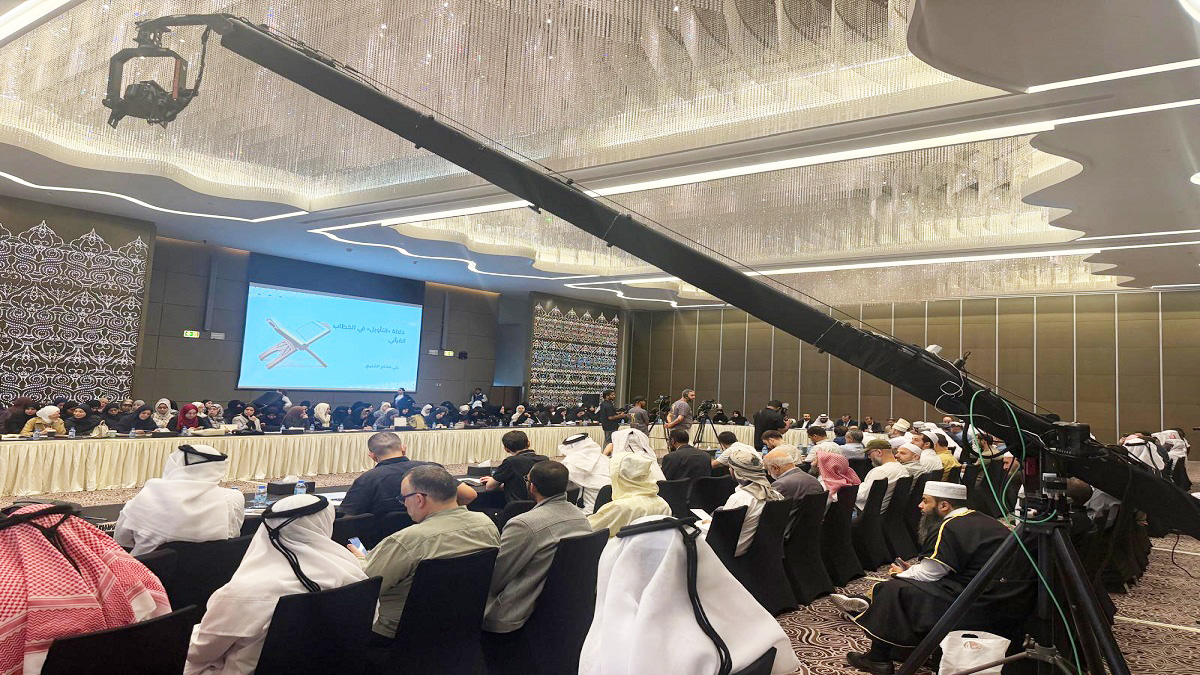
The second day’s program featured a rich package of general lectures and panel discussions approaching the Quranic text from the angles of Surah guidance and contemporary reality:
- Sheikh Mustafa Al-Shaibani opened with reflections on Surah Al-Baqarah and building the foundations of civilization.
- Sheikh Masoud Lantong reviewed the path of the Quran’s spread in the Philippines and its impact on rooting guidance.
- Dr. Mohammad Al-Noubani addressed Surah Al-Muzzammil as a pillar for educational and leadership foundation.
- Dr. Mohammad Al-Jassim dismantled the arguments of cognitive arrogance in Surah Al-Jathiyah.
- Dr. Jamila Khalief elicited the system of istikhlaf (stewardship) and sound governance in facing crises from Surah Yusuf.
- Jamal Al-Din Othman paused at the story of the owner of the two gardens to critique capitalist economic arrogance.
- Yahya Rabi derived the divine laws of empowerment for the oppressed from Surah Al-Qasas.
- Fidaa Al-Din Yahya highlighted “The Most Upright Path of the Quran in Media and Public Opinion Formation.”
- Heba Najai tackled the Quran’s exposure of media disinformation mechanisms, taking Surah Al-Shu’ara as an analytical model.
The program culminated in a striking interactive momentum via two platforms dedicated to the rising generation:
- A specialized session titled “The Quran in Youth Consciousness,” featuring Abdullah Al Thani, Muthanna Al-Shafri, Abdullah bin Muhammad, Abdul Bari Al-Alami, and Malik Al-Shatti.
- A dialogue seminar titled “The Quran in the Consciousness of Future Men,” enriched by Dr. Abdullah Al-Emadi, Abdullah Al-Mohannadi, Ammar Khaled, and Loay Hamza.
Nayef bin Nahar: Al-Aqwamiyya as a Thinking Methodology and Starting Point for Building and Correction
In his speech during the second day, Dr. Nayef bin Nahar, Head of the Waii Foundation for Studies and Research, set the intellectual record straight. He explained that the fundamental goal does not stop at proving the greatness of the Quran—since the entire nation acknowledges its greatness—but rather lies in overcoming the chronic methodological confusion regarding how to operationalize Al-Aqwamiyya in human and cognitive reality.
Dr. Nayef presented a practical model to illustrate the idea: If we want today to establish a school or formulate an educational theory, how do we do it? According to his diagnosis, the prevailing path today is inverted and defeatist. Researchers rush to Western books on education, psychology, and sociology, review the theses of Piaget, Dewey, and Rousseau, and formulate a Western educational model according to its environment and ideology. Then, once the structure is complete, they return to the Quran looking for a verse here and a hadith there to “sprinkle” over the model and give it a superficial Islamic veneer! Dr. Ben Nahar described this path as a distortion and an explicit departure from the logic of the Quran’s upright path.
Dr. Nayef explained that the logic of Al-Aqwamiyya is based on two simultaneous operations: Building and Correction:
- Building: Making the Glorious Quran the primary and highest starting point. We go to the Quran first to extract educational vocabulary, educational models, psychological characteristics of the learner, educator responsibilities, and the existential goals of education. After constructing this solid foundation entirely from within revelation, we then turn to general human production to benefit from its tools, experiences, and techniques that do not contradict our principles.
- Correction: Ensuring the Quran remains the scale and criterion by which we weigh all incoming ideas and experiences. If we hear an idea that sounds beautiful and glossy, we do not rush to accept and be infatuated with it; instead, we ask the primary normative question: What is the Quran’s stance on it?
Dr. Nayef stressed that contemplation of the Quran is not intended for its own sake, but is a means leading out of heedlessness. The father who contemplates the verses of Luqman and his guidance to his son is not merely enjoying the text’s eloquence; rather, he discovers the severe flaw in his contemporary methods of raising children and rises to escape the consumerist upbringing model drowning in material pampering, turning toward a tawhidic upbringing model based on instilling identity, assuming responsibility, lowering the wing of humility, and nurturing certainty in divine oversight.
Mustafa Abu Al-Saad: The Family – A Divine Sign or a Contractual Corporation?
Dr. Mustafa Abu Al-Saad, a well-known educational and psychological expert, presented a heavy-weight intellectual and educational plea, analyzing the upright path of the Quran in building the family model and confronting the modernist deconstructive assault.
Dr. Abu Al-Saad affirmed that the Quranic starting point for the family differs radically and confrontationally from the Western vision. The Quran establishes that the family is “a sign among the signs of Allah in His creation, not a mere biological necessity,” citing verse:
{And of His signs is that He created for you from yourselves mates that you may find tranquility in them; and He placed between you affection and mercy} [Ar-Rum: 21].
In contrast, the Western model portrayed the family as a “utilitarian partnership or contractual corporation between two independent parties, where each party stands waiting to pounce on the other, calculating accounts by dirham and dinar, dividing property upon dispute, and arbitrating by the logic of power and extreme individualism.” Dr. Abu Al-Saad expressed deep regret over the leakage of this distorted Western model into the minds of some psychiatrists and family counselors in the Islamic world—even those counted among the religious—to the point where they promote the family as a consumerist biological necessity.
Dr. Abu Al-Saad refuted a claim repeated by some therapists alleging that “the primary and foundational purpose of establishing a family is physical gratification, and that if sexual gratification falters, the family inevitably collapses.” He strongly responded: “Praise be to Allah! Does the family and the model of tranquility rest upon instinctual gratification?! Scientifically and Quranically: instincts are not satisfied; they are quenched and extinguished! What is satisfied are needs! Instinct is not a foundational need upon which a cosmic edifice is built; it is like dessert after a complete meal comprising meat, fruits, vegetables, and major nutritional values. If there is room left, we have dessert—that is instinct. But turning dessert into the foundation of the building demolishes the concept of the family as a divine sign.”
Dr. Abu Al-Saad also deconstructed the deep miraculous meaning of His saying: {from yourselves} (Min Anfusikum). He explained that human nature is innately inclined toward self-love, and Islam acknowledged this innate love, as the Prophet ﷺ stated: “None of you truly believes until he loves for his brother what he loves for himself.” The prophetic text adopted self-love as an accepted principle upon which the perfection of faith is measured. Since the wife was created from her husband’s own self and both spouses became “one divided self,” their interactions should overflow with the love of the self itself, rather than the logic of competing partners fighting over influence, possessions, and decision-making power.
Media Disinformation in Surah Al-Shu’ara
The second day featured a vibrant presence of the nation’s pressing issues, chief among them the Al-Aqsa cause and the ongoing genocide in the Gaza Strip. Researcher Heba Najai presented an analytical paper exposing the Quranic miracle in exposing the manufacture of media disinformation and the sociology of falsification through Surah Al-Shu’ara.
The presentation showed how the arrogant ones and Pharaoh confronted Moses’ call with psychological warfare, summoning magicians as a media arm wielding power and propaganda, falsifying the collective consciousness of the masses, and inverting concepts by making the reformer a corrupter and the criminal a victim. The researcher compared this pattern to the methods of the Zionist occupation and biased Western media in handling war crimes, emphasizing that the Glorious Quran presents strict laws for honest media discourse and exposes the flaws of the tyrannical media machine seeking to terrorize the oppressed and bend their will.
Youth and teenage sessions, led by a group of researchers and preachers, also witnessed frank dialogues and disclosures regarding identity crises, cognitive doubts, and digital challenges, showing how the Glorious Quran can serve as an existential fortress restoring the compass of youth in a world surging with atheistic and moral fluidity.
Day Three: Rigorous Scientific Sessions
The third and final day was the pinnacle of the Forum and its pure academic peak. Scientific arbitration committees spent months sorting 146 specialized scientific research papers submitted from universities and research centers worldwide, selecting 8 rigorous qualitative papers that were presented and discussed in morning and evening sessions characterized by critical depth and methodological boldness.
Deconstructing Models and Vocabulary on the Scale of Al-Aqwamiyya
The morning scientific session was chaired by Prof. Dr. Loay Khalil and featured five consecutive research papers that sparked sharp and fruitful discussions.
- Dr. Lahlou Bukhari – “The Quranic Model of the People of Shu’ayb”: Dr. Bukhari opened the last day’s sessions with an in-depth presentation of his Quranic-economic study, “The Quranic Model of the People of Shu’ayb: The Normative Exegesis of Economic Rationality Establishing Absolute Ownership and Institutional Underselling.” He tackled the foundational claims of contemporary capitalism and runaway market economics by interrogating the story of Prophet Shu’ayb and his people in Madyan. Dr. Bukhari explained that the economic deviation of the people of Shu’ayb was not merely a passing individual thievery behavior, but an “institutional underselling” stemming from an ideological vision considering property an absolute right for the owner to dispose of freely without religious or moral constraints:
{They said, “O Shu’ayb, does your prayer command you that we should leave what our fathers worshiped or not do with our wealth what we wish?”} [Hud: 87].The researcher noted that the Quran confronted this corrupt vision with the concept of “economic vicegerency.” Wealth belongs to Allah, man is a vicegerent trustee, and freedom of disposition is restricted by the sanctity of aggression, spreading societal prosperity, and preventing wealth monopolization. - Dr. Ali Al-Maghdi – “The Glorious Quran and Theory Generation in Human Sciences”: Dr. Al-Maghdi presented a heavily theoretical paper titled “The Glorious Quran and Theory Generation in Human Sciences: Quranic Criticism as a Model: A Study in Criticizing the Restriction of the Quran’s Cognitive Function to Guidance and Preaching.” He addressed the claims of orientalists and some Muslim researchers who restrict the Quran’s function to preaching, warning, and glad tidings, denying its ability to generate theories in human sciences. Dr. Al-Maghdi asked: If we present the Quran’s miracle to a Chinese academic or a Western sociologist, do we tell him to look at its eloquence while he doesn’t know the basics of Arabic? The contemporary miracle of the Quran is presented through the language of human sciences and foundational theories, leading to the generation of a “(Theory of Quranic Criticism).”
- Dr. Abdul Mawla Al-Ziyout – “The Quranic Usage of the Word (Ar-Rahaq)”: In a linguistic and contextual paper, Dr. Ziyout presented his field study, “The Quranic Usage of the Word (Ar-Rahaq): A Contextual Semantic Study in its Social, Political, Psychological, and Educational Dimensions,” confirming that Quranic usage places every word in its precise location without the slightest synonymy. He demonstrated the phonetic-miraculous dimension of the word (Ra’ for continuous pressure; Ha’ for a breathed-out, breath-draining sound; Qaf for restriction and compression). He analyzed its lexicographical meaning (enveloping, compulsory attachment, exhaustion) and reviewed four major applied contexts in the Quran: political/social (exhaustion of societies and economy of fear), psychological/eschatological, educational/pedagogical, and emotional/suspicion-driven values.
- Dr. Alya Ali Sayed – “Semantic Contexts of the Root (H-J-R)”: Dr. Alya presented a solid paper tracking the semantic shifts of the root “Hajar” in the Glorious Quran, which shares a single conceptual root of “separation and distancing,” revealing a unique contextual architecture spanning six progressive stages: separation in stance/behavior without leaving place; spatial/physical separation (Hijrah for the sake of Allah); semantic shift from temporary action to permanent attribute; the migrating community and alliance with the Ansar; pairing Hijrah with Jihad; and the inversion of separation (abandoning the Glorious Quran).
- Dr. Latifa Al-Kaabi – “Iblis: The First Quranic Model Opposing Infallibility”: Dr. Al-Kaabi addressed the psychological and intellectual roots of the first sin in existence, going beyond mere historical narrative to analyze how racist thought and rebellion against divine command formed. She posited three major hypotheses: material preference/differentiation (racism based on fire vs. clay); transition from sin to justification and vengeance; and the institutionalization of temptation.
Lessons in Criticism, Deconstruction, and Correcting the Course
The scientific session was followed by an expanded critical dialogue enriching the contents.
- Dr. Abdullah Al-Qaisi affirmed that Allah provided mankind with two accompanying lights for guidance: the light of inner intellect and the light of outer Quranic revelation. He critiqued both the illusion of relying solely on intellect and of marginalizing it under the guise of glorifying the text.
- Dr. Saad Al-Qubaisi focused on the thesis of Dr. Ziyout and Dr. Alya Sayed, providing a precise methodological framing of “context,” dividing Quranic meaning into three necessary levels: lexical vocabulary, functional-contextual level, and ultimate purposeful level (maqasid).
- Dr. Sulaiman Al-Daqour methodically decontaminated several concepts in the papers of Dr. Latifa Al-Kaabi and Dr. Ali Miftah Al-Shiniti, presenting four/five levels of tadabbur (vocabulary, immediate context, Surah context, semantic field) and liberating the term Tafseer from custom-based projection. He noted that the Quran is a book of interpretation for reality and existence, not a book waiting to be interpreted by external human concepts.
- Dr. Nayef bin Nahar delivered a lecture dedicated to untangling the historical and cognitive entanglement between the “Islamization of Knowledge” project of the 1970s/80s and the “Al-Aqwamiyya of the Quran” project. He outlined six scientific criteria serving as indicators of adherence to Al-Aqwamiyya:
- Methodological Criterion (Where does thinking begin? Revelation as the first step).
- Terminological Criterion (Consciousness gates; replacing terms like “international conflict” with “Quranic pushing/tadafa'”).
- Conceptual Criterion (Quranic definitions vs. modern secular definitions of man, success, progress).
- Objective Criterion (Priorities of Quranic research, returning to major themes).
- Applied Criterion (Continuous institutional evaluation).
- Stylistic Criterion (Disputing in the best manner, Bi-allati hiya ahsan).
Dr. Nayef then deconstructed the crisis of the “Islamization of Knowledge” project, pointing to two serious structural slips:
- Mental confusion: Assuming Muslim researchers must first master Western knowledge before Islamizing it, which causes them to spend decades soaking in Western paradigms and viewing the Quran through Western lenses.
- Marginalization of the Quran: Leading to the tragic paradox where Muslim academics know the Western “other” better than themselves and their Lord’s Book.
He contrasted Imam Al-Ghazali’s handling of Greek philosophy with contemporary approaches, noting that Al-Ghazali debated Aristotle and Plato from a position of robust civilizational sovereignty, free from Western academic accreditation boards. In contrast, modern researchers navigate “Islamization” under the weight of psychological defeat and military/academic dependency. He concluded by emphasizing that the “Al-Aqsa Flood” battle was an earthquake exposing the moral bankruptcy and fragility of the Western paradigm.
Concluding Recommendations of the Global Quranic Forum
At the conclusion of the third day of the “First Global Quranic Forum: Al-Aqwamiyya of the Quran,” the scientific and organizing committee read out several recommendations:
- Reactivating the Foundational Quranic Reference: Transitioning the Glorious Quran from the circle of blessing and subsequent decorative citation to the primary starting point for cognitive building and correction across all scientific, social, political, and educational initiatives.
- Shifting Toward Applied Contemplation and Institutionalizing Models: Moving Quranic contemplation out of lecture halls and preaching assemblies into realistic action programs and educational/societal models.
- Breaking the Monopoly on Revelation: Inviting academics and specialists in natural, human, social, and professional sciences (medicine, engineering, economics, politics, media, psychology) to study the Quran from the angles of their specializations, without restricting its guidance solely to sharia and language scholars.
- Fortifying the Family and Innate Consciousness: Formulating an Islamic family charter derived from Quranic Aqwamiyya, confronting modernist concepts that commodify the family or reduce it to contractual conflicts.
- Institutionalizing and Sustaining the Global Quranic Forum: Transforming the Forum into a permanent annual global knowledge institution, platform, and gathering hosted in Doha, under whose auspices specialized research teams are established to monitor Quranic terminology and generate upright theories.
Read more at: “The First Global Quranic Forum: Al-Aqwamiyya of the Quran” .. From Recitation and Preaching to Knowledge Engineering
